
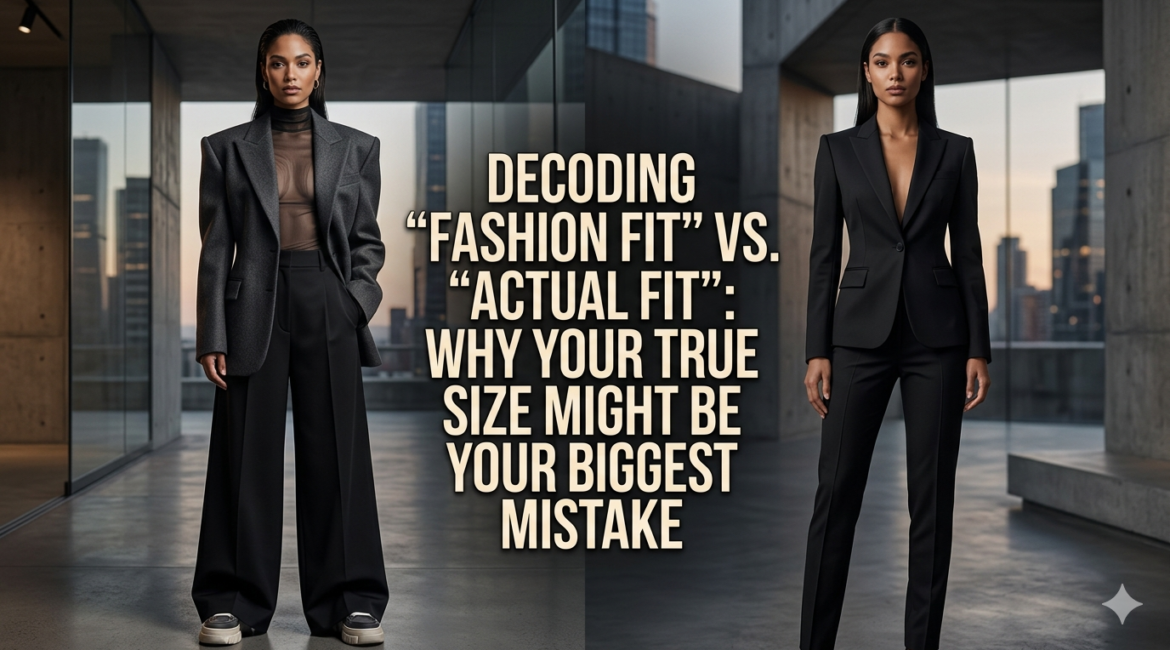
In the fast-paced world of 2026 fashion, the numbers on your garment tag have become increasingly irrelevant. We have officially moved past the era where a “Medium” is a universal constant. Today, the industry is divided by a complex psychological and technical gap: the Fashion Fit versus the Actual Fit. Understanding this distinction is no longer just for stylists; it is a vital skill for anyone looking to master the art of modern dressing. ✨
Most shoppers fall into the trap of buying their “true size,” only to find the garment looks awkward, dated, or simply “off.” This happens because high-end designers and streetwear architects now design for a specific silhouette—an intended vibe—rather than just body measurements. Whether it’s the exaggerated volume of avant-garde techwear or the razor-sharp lines of luxury tailoring, your actual size might be the very thing holding your style back. 👗
Therefore, achieving a 10/10 look requires a mindset shift. You aren’t just covering your body; you are sculpting a silhouette. In this exhaustive guide, we will break down the technicalities of garment construction, the psychology of sizing, and how you can manipulate “Fashion Fit” to look like a street-style icon. 🖤
The Technical Anatomy of Fashion Fit
The Fashion Fit refers to how a designer intends a piece to hang on the body, regardless of the size label. For instance, a “Fashion Fit” oversized hoodie is engineered with dropped shoulders and a cropped hem. If you buy your “Actual Fit” size in this style, it may look like a hand-me-down rather than a curated choice.
Moreover, different brands use different “blocks” or master patterns. A European luxury brand’s “Large” is often closer to an American “Small.” Consequently, relying on the tag is a recipe for a wardrobe disaster. You must learn to read the garment’s architecture—looking at the shoulder seams, the drape of the fabric, and the taper of the waist—to understand how it is meant to perform in the real world. 🧥
Why the “Oversized” Trend is Misunderstood
The biggest mistake people make with the oversized trend is thinking it simply means “big.” In reality, true oversized fashion is a precise calculation. A high-quality oversized tee has a tightened neck and structured sleeves so that the wearer doesn’t look “lost” in the fabric.
However, when you buy a standard shirt three sizes too big to mimic this look, the proportions fail. The neck sags, and the sleeves become too long, ruining the modern American loungewear style that relies on intentional volume. To master this, look for pieces labeled “Relaxed” or “Boxy” in your actual size, rather than sizing up on standard cuts. 👟
The Science of Silhouette: Compression vs. Volume
Fashion in 2026 is a game of contrasts. The most successful outfits balance Actual Fit (items that follow the body’s natural lines) with Fashion Fit (items that distort or enhance those lines). Think of a pair of skin-tight performance leggings paired with a massive, structured puffer jacket.
Meanwhile, this interplay creates visual interest. If everything is “Actual Fit,” the outfit can look boring or like a uniform. If everything is “Fashion Fit” (all oversized), you lose your shape entirely. The goal is to use technical sizing to highlight your best features while letting the clothes do the heavy lifting of looking “high fashion.” 👜
Celebrity Inspiration: Mastering the Intentional Mismatch
Look at how modern icons handle their proportions. They rarely wear clothes that “fit” in the traditional sense. A celebrity might wear a blazer that is technically four sizes too large in the shoulders but tailored perfectly at the wrists. This creates an authoritative, “Power Suit” silhouette that a standard fit simply cannot achieve.
In addition, pay attention to how they utilize urban woman fashion 2026 trends. They often mix gendered sizing—women wearing men’s “Small” shirts for a stiffer, boxier “Fashion Fit” that female-marketed shirts (which are often contoured) don’t provide. This is a pro-tip for anyone wanting to achieve that effortless, “model-off-duty” aesthetic. 📸
Fabric Insights: How Material Changes Your Size
The “Actual Fit” of a garment changes based on the textile. A 100% heavy cotton denim will feel smaller than a stretch-blend denim of the same measurement. Consequently, you must account for “fabric give” when choosing your size.
- Natural Fibers: Cotton, wool, and silk tend to hold their shape or shrink. You may need to lean toward a “Fashion Fit” that is slightly looser.
- Synthetic Tech-Blends: These often have 4-way stretch. Here, your “Actual Fit” is your best friend to avoid a sloppy appearance.
- Structured Leathers: These require a “break-in” period. Buying a “Fashion Fit” that feels tight initially is often the right move as it molds to your body over time. 💎
3 Step Guide to Finding Your Perfect “Fashion Fit”
- Identify the “Vibe”: Before looking at the size, ask if this piece is meant to be Sharp, Flowy, or Boxy.
- Measure the Shoulders: The shoulder seam is the only “truth” in fashion. If it’s on your natural shoulder, it’s a classic fit. If it’s 2-3 inches down, it’s a deliberate “Fashion Fit.”
- The Sit Test: Always sit down in your “Actual Fit” clothes. If the buttons strain or the thighs pinch, the “Fashion Fit” of that brand is not aligned with your body type, and you should size up regardless of the label. 🔥
Common Fashion Mistakes: The “True Size” Trap
The most common mistake is the “Ego Fit”—insisting on buying a size Medium because you have “always been a Medium.” Brands change their sizing (Vanity Sizing) constantly. Therefore, ignoring the mirror in favor of the label is a stylistic dead end.
Another mistake is failing to tailor “Fashion Fit” pieces. Just because a shirt is meant to be oversized doesn’t mean the sleeves should cover your fingers. A quick trip to the tailor to fix the sleeve length while keeping the body wide can make a $50 shirt look like a $500 timeless fashion piece. ✂️
Seasonal Tips: Transitioning Fits for 2026
In the winter of 2026, we are seeing a return to “Layered Volume.” This means your base layers (turtlenecks, thermals) should be your “Actual Fit,” while your outer shells (trench coats, bombers) should be your “Fashion Fit.” ❄️
During the summer, the “Fashion Fit” leans toward “Breathable Minimalism.” This involves wide-leg trousers that are technically 2 inches too long, designed to be worn with platform sneakers. This creates a lengthening effect that “Actual Fit” trousers simply cannot provide. 🌸
7 Trending Products to Redefine Your Fit in 2026
1. The Architectural Boxy Tee
This isn’t your average gym shirt. It features a heavy 300GSM fabric that holds a rigid shape, creating a “Fashion Fit” that stands away from the body. It hides imperfections and provides a clean, minimalist silhouette.
- Benefits: Durable, sweat-wicking, and high-fashion aesthetic.
- Styling: Pair with slim-fit tech trousers for a balanced look.
- Why Trending: The shift toward “Quiet Luxury” demands structured basics. []
2. High-Rise “Fluid” Trousers
These trousers use a blend of rayon and wool to create a “Fashion Fit” that moves like liquid. While they fit your “Actual” waist perfectly, the legs are intentionally voluminous.
- Benefits: Extremely comfortable for office or travel.
- Styling: Wear with a tucked-in fitted tank top.
- Why Trending: 2026 is seeing a departure from stiff office wear. []
3. The “Exaggerated” Shoulder Blazer
A nod to the 80s but with a 2026 technical twist. The shoulders are padded beyond the “Actual” frame to create an hourglass shape for any body type.
- Benefits: Instant confidence booster; creates a powerful presence.
- Styling: Best worn over luxury lounge sets USA for a “high-low” mix.
- Why Trending: Power dressing is dominating the 2026 runways. []
4. Technical Micro-Gilet
A slim, functional vest designed for an “Actual Fit.” It’s meant to be worn under coats or over hoodies without adding bulk.
- Benefits: Adds warmth and pocket utility without ruining the silhouette.
- Styling: Layer over a monochrome hoodie.
- Why Trending: The “Utility” trend remains a staple in urban environments. []
5. Asymmetric Knitwear
This piece defies standard sizing. One side might be a “Fashion Fit” oversized drape, while the other is a fitted sleeve. It is a masterclass in modern geometry.
- Benefits: A conversation starter that requires no accessories.
- Styling: Keep the bottom half simple with dark denim.
- Why Trending: 2026 fashion is embracing “imperfection” and unique cuts. []
6. The “Second Skin” Mock Neck
Designed for a compressed “Actual Fit,” this base layer uses smart-fiber technology to regulate body temperature.
- Benefits: Sleek profile; perfect for layering.
- Styling: Use as a base under an oversized “Fashion Fit” flannel.
- Why Trending: Tech-wear and aesthetics are merging into everyday wear. []
7. Sculptural Cargo Pants
Unlike the baggy cargos of the past, these 2026 versions have a “Tapered Fashion Fit.” They are wide at the thigh but snap shut at the ankle.
- Benefits: Offers the comfort of joggers with the look of high-end streetwear.
- Styling: High-top sneakers are a must.
- Why Trending: Practicality meets style in the “Post-Gorpcore” era. []
Conclusion: The New Rule of Sizing
The secret to being well-dressed in 2026 is simple: Stop buying clothes that just “fit” and start buying clothes that “work.” Your “Actual Fit” is a measurement of your body, but your “Fashion Fit” is a measurement of your style.
Moreover, don’t be afraid to experiment. Buy that XL hoodie if the drape looks better; buy those “Small” trousers if you want a cropped, sharp look. Fashion is a visual language, not a math equation. Therefore, use your size as a starting point, not a cage. By mastering these technical nuances, you turn a simple outfit into a curated masterpiece. Stay bold, stay stylish, and remember: the tag belongs in the trash, but the style is forever. ✨
FAQ Section
Q1: How do I know if I should size up for a “Fashion Fit”? If the garment is designed to look “Oversized” or “Boxy,” check the shoulder seams. If they are already dropped, stay with your “Actual Fit” size. If the garment is a “Standard Fit” but you want the trend look, size up by two.
Q2: Can “Actual Fit” still be stylish in 2026? Absolutely! The “Actual Fit” is essential for base layers and classic tailoring. The key is to mix one “Actual Fit” item with one “Fashion Fit” item to create a modern, balanced silhouette.
Q3: What is “Vanity Sizing”? Vanity sizing is when brands label a garment smaller than it actually is to make customers feel better. This is why you might be a Small in one store and a Large in another. Always check the cm/inch chart!
Q4: Should I tailor my oversized clothes? Yes. An intentional “Fashion Fit” still needs to respect your proportions. Tailoring the length of the sleeves or the hem while keeping the width of the body is the secret to looking polished.
Q5: Does “Fashion Fit” work for all body types? Yes, and it is often more flattering. For example, a boxy “Fashion Fit” tee can provide more structure and a cleaner line for larger body types than a clingy “Actual Fit” shirt.
Q6: What fabrics are best for a structured “Fashion Fit”? Look for high-density cotton (GSM 250+), neoprene blends, and heavy-weight wool. These fabrics have the “memory” to hold a shape regardless of your body’s contour.
Q7: Is “Fashion Fit” the same as “Streetwear”? While streetwear popularized the “Fashion Fit” movement, it is now seen in luxury tailoring and even office wear. It is a design philosophy, not just a specific style category. 🌟
